Gambling vs. Investing: What's the Difference?

What you'll learn
- The difference between gambling and investing
- Why both involve risk—but in very different ways
- What it means to own an investment versus place a bet
- How knowing the difference can help you make smarter decisions
These days, it takes just a few taps on your phone to do almost anything with your money. From investing in companies to placing bets on sports, or even wagering on what might happen next in the world around you. On the face of it, investing and gambling could sound kind of the same. Both involve putting your money toward something, with the potential for a positive return in the future.
But there are some pretty big differences between disciplined investing and any type of gambling. Knowing the difference can help you make smarter decisions with your money now—and later in life. Namely:
Investing is about ownership. When you invest in something like a stock, you're buying a small piece of a real company. Instead of betting on a single outcome, you're giving your money a chance to grow over time as that company grows.
Gambling is a game of chance. You're betting money on a specific outcome and hoping you're right. If you win, you make money. If you don't, you lose what you bet.
Think of it this way:
- Investing: "I own a piece of this."
- Gambling: "I hope this happens."
Why people could get them mixed up
It's easy to see why investing and gambling could sometimes be confused. Both involve money. Both involve risk. And both can have winners and losers.
And when you're scrolling social media or watching any big game, posts or ads for online betting apps seem to pop up everywhere, making bold promises of easy money. Some of these apps even look like investing apps—similar to the ones you'd use to purchase stocks.
But underneath the hype, there's one major difference: Investing is designed to help people build long-term wealth over time, while gambling is designed for short-term entertainment.
That's why understanding the difference matters—especially when you're just starting to make decisions about money.
Gambling can feel like a game—but the stakes are real
When you place a bet, it means putting money on a short‑term outcome you don't control, like who will win the Super Bowl, or which couple will be crowned winners on this season of "Love Island."
Sure, you might get it right sometimes. But the odds are actually set up so most people lose money when they keep betting.
And it's not because they had bad luck, made bad picks, or didn't try hard enough. They lose because the odds are stacked against them from the start.
That's not a secret—it's how the system works: The entire gambling universe is built so the house wins in the long run.
Source: Schwab Center for Financial Research. This hypothetical example is only for illustrative purposes. Past performance is no guarantee of future results.
So, gambling may be entertaining, but it's not a very good strategy for growing your money.
Here's why.
Investing is being in the game, while gambling is sitting on the sidelines
When you place a bet, you're just sitting on the sidelines hoping for a win. But win or lose, the game is over, and you have to keep gambling to go on. (And you know how that turns out.)
On the other hand, when you invest, you're buying a real piece of a real business and their future cash flows. You're an owner now! And you're participating in the company's potential for long‑term growth.
That's where the difference starts to show.
Historically, diversified investments held for long periods have delivered positive returns.
Even though results aren't guaranteed and investments can lose value, investing over time increases the chances that your money can grow in a way gambling never can.
And that leads to your greatest advantage: time.
The longer you can invest, the more your potential growth
Let's say Sarah takes $100 from her paychecks working at the frozen yogurt shop and invests it in the Schwab 1000 Index Fund every month and continues for 20 years. At the end of that time, Sarah will have invested $24,000 total. But with potential market returns and compound growth—which is her money making money—her initial investment could have grown to nearly $105,000.
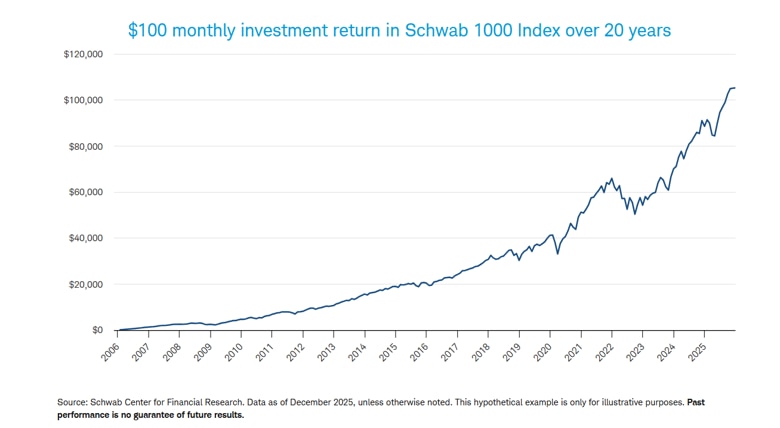
But if Sarah had placed $100 on a losing bet rather than invested it, it's not just gone but she would have also lost the chance to grow it year after year.
By investing that bet in the market instead, she could be able to see that compound growth add up to potentially 4x her original investment.
Four key differences to remember
1. Timeframe: Play the long game
Gambling: Short‑term; with immediate outcomes.
Investing: Long‑term; designed for goals years in the future.
Gambling is about now—win or lose and it's done. But investing uses one of your greatest advantages—your youth—to potentially grow your money over a longer period.
2. Expectations: Gambling odds are not in your favor
Gambling: Has a negative expected return over time; the odds favor the house.
Investing: Has historically rewarded patience and staying invested over longer periods.
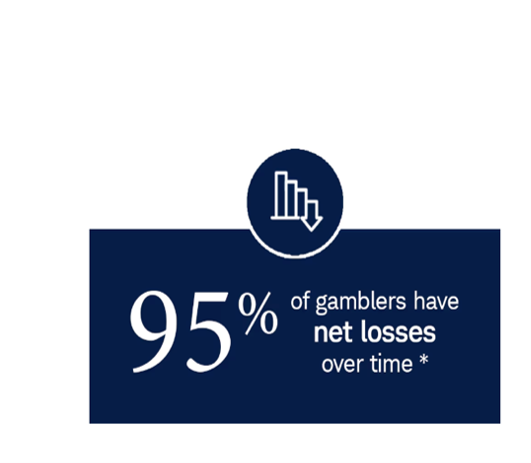
Research has shown that 95% of gamblers have net losses over time.1 No matter how long you gamble, the odds don't improve! With investing, time has historically made a difference. (Check that chart again to see how a $100 monthly investment could grow.)
3. Risk and control: With investing, you have more ways to manage risk
Gambling: High risk/low control; outcomes mostly depend on chance.
Investing: Calculated risk/tools to control; risk can be managed using diversification, research, and a long‑term plan.
You know the odds work against participants over time, but betting sites and prediction markets often hide the risks of gambling behind the fun, fast games. Investing isn't risk‑free, but the risks are identifiable and there are tools to help manage it that can work for you over time.
4. Your goal: Entertainment, or building wealth
Gambling: Entertainment and excitement; hoping for a quick win.
Investing: Building financial security and future opportunities; being an owner.
If something feels more like adrenaline than a plan, that's a clue you're gambling. Remember: Gambling is about hoping; investing is about owning. And owning investments means thinking about all the things you dream of doing—taking a trip, buying a house, starting a business—for future you.
Owning beats hoping.
Investing means owning a piece of real assets and letting time and compounding work. Gambling is hoping for a win but built so the house wins over time.
Own your future—don't bet on it
If you're unsure whether something is investing or gambling, ask yourself:
- Am I owning something—or just hoping for a win?
- Is this going to help me grow my money over time?
- Are the odds structured so most people lose in the long run?
If it's ownership, time, and discipline—it's investing. If it's short‑term bets and excitement—it's gambling. Building wealth isn't about chasing excitement around a one-time event. It's about ownership, discipline, and thoughtful planning for the long-term.
Quiz
1. Which option best describes investing?
A. Betting money on a single game or event
B. Hoping for a quick win and cashing out fast
C. Buying ownership in something and letting it grow over time
D. Making a guess based on what's trending online
Answer: C | Nice work! Investing means owning something—like a company or a group of companies—and giving it time to grow.
2. Why do most people lose money when gambling over time?
A. They don't bet enough money
B. The odds are designed to favor the house
C. They stop playing too early
D. They don't follow betting tips closely enough
Answer: B | You've got it. You may win occasionally, but it's usually just to keep you playing. Gambling systems are built so the house wins in the long run—they make money, not you.
3. Which question can help you tell the difference between gambling and investing?
A. Is this popular right now?
B. Does this promise fast results?
C. Am I owning something or just hoping for a win?
D. Do other people say it worked for them?
Answer: C | Exactly. Investing is based on ownership and time—gambling is based on short‑term outcomes and chance.
Your next steps
- Practice the gut check. When something promises quick money, pause and ask whether it's built on ownership and time—or just hoping for a short‑term outcome.
- Focus on learning, not winning. Confidence with money starts by understanding how investing works, not by chasing fast results.
- Think long‑term. Your biggest advantage right now isn't how much money you have—it's how much time you have. Give your future self the edge.
- Explore more money ideas at Schwab Moneywise Teens.
1 2024 working paper by economists Scott R. Baker, Justin Balthrop, Mark J. Johnson, Jason D. Kotter, and Kevin Pisciotta—"Gambling Away Stability: Sports Betting's Impact on Vulnerable Households"